7 Benefits of Industrial Air Curtains for Modern Businesses
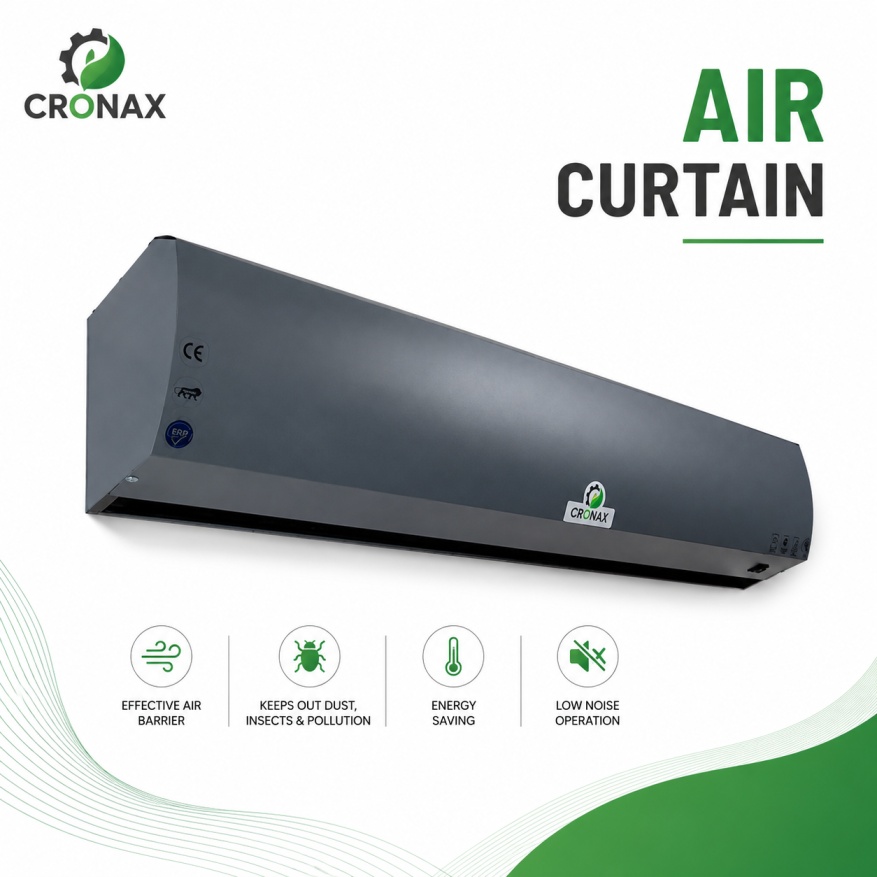
Most businesses spend serious money on HVAC systems, insulation, pest control, and contamination management — and then leave a wide-open doorway that quietly undermines all of it.
Every unprotected entry point in a factory, warehouse, food unit, or commercial space is a gap where energy escapes, insects enter, dust drifts in, and conditioned air walks out.
An industrial air curtain fixes this with a single installation. It creates an invisible high-velocity air barrier across the doorway — keeping inside conditions inside and outside conditions outside — while traffic flows through freely.
Here are 7 genuinely useful benefits that explain why air curtains have become standard equipment in modern Indian businesses.
1. Significant Energy Savings — Every Single Day
This is the number most facility managers pay attention to first.
HVAC and refrigeration systems account for a major share of operational electricity costs in factories, warehouses, and commercial buildings. Every time a doorway is open — even briefly — conditioned air escapes and unconditioned outdoor air enters. The cooling or heating system compensates. The meter runs.
A properly installed industrial air curtain reduces this infiltration by up to 80%. For a mid-sized warehouse or food processing unit running air conditioning through India's long summer, that reduction translates to 20% to 30% less electricity consumption on climate control alone.
The payback period on a well-specified air curtain is typically 6 to 18 months. After that — pure savings, every operating day.
2. Effective Insect and Pest Control — Without Chemicals
India's warm climate means insect pressure is a year-round concern for food businesses, pharmaceutical units, and any facility where hygiene standards are audited.
An industrial air curtain creates a physical and aerodynamic barrier that flying insects cannot comfortably cross. High-velocity airflow at the doorway disrupts their flight path and deters entry more effectively than strip curtains or slow-closing doors that leave gaps during every opening.
Amber anti-insect air curtains add an optical deterrent — a specific tint that insects find inhospitable — on top of the airflow barrier. For FSSAI-audited food facilities, this two-layer approach at every external entry point is a visible and documentable contamination control measure.
No sprays. No traps. No chemicals near food or product contact surfaces.
3. Dust and Pollutant Control — Critical in Indian Industrial Zones
Dust is not just an aesthetic problem in Indian industrial facilities.
Fine particulate matter from road traffic, construction activity, and dry seasonal winds infiltrates unprotected openings continuously. In electronics assembly, pharmaceutical manufacturing, and food processing — dust on product or equipment surfaces creates quality failures, compliance gaps, and customer returns.
Industrial air curtains at loading docks, production area entries, and external-facing openings actively block airborne dust. The air stream pushes incoming particles back without blocking traffic. In industrial zones across Delhi-NCR, Pune, Ahmedabad, and Chennai — where ambient particulate levels are consistently elevated — this protection is both operational and regulatory value.
4. Worker Comfort — More Valuable Than It Sounds
A worker standing near an unprotected loading bay in a Nagpur summer deals with heat blasts every time a vehicle passes. A warehouse picker near an external entry in Mumbai's monsoon gets hit with humid air and rain spray on every truck movement.
Neither condition is comfortable. Both affect productivity. Heat stress in Indian industrial workplaces is a genuine safety and performance concern — not just a welfare issue.
Air curtains stabilise the working environment at high-traffic entry points. The temperature and humidity around the opening stay closer to the interior conditions — making a measurable difference to the people working near those areas for eight to twelve hours a day.
Worker comfort isn't a soft benefit. It affects attendance, output quality, and the rate at which experienced staff stay in physically demanding jobs.
5. HVAC and Refrigeration System Protection
Here's a benefit that often gets missed in the headline conversation about air curtains.
Every time warm, humid air infiltrates a cold room or air-conditioned space through an unprotected doorway, the refrigeration compressor or HVAC unit has to compensate. It runs longer, works harder, and carries more load than its design intended.
Over months of this pattern, compressor life shortens. Service intervals compress. Refrigeration efficiency drops as evaporator coils frost more frequently from repeated warm-air infiltration.
An industrial air curtain reducing infiltration by 80% directly reduces this load on the refrigeration or HVAC system behind the door. Compressors run closer to design parameters. Service intervals extend. Equipment life increases.
For cold chain operators in India — where refrigeration downtime directly affects product integrity and compliance — this secondary benefit is worth calculating into the investment decision.
6. Hygiene Zone Separation — Without Walls
Modern food processing, pharmaceutical, and healthcare facilities operate with multiple hygiene zones — different cleanliness standards in adjacent areas that need to stay functionally separated.
Industrial air curtains maintain this separation at doorways without requiring physical walls or doors that slow down operations. A high-care food production area and an adjacent packaging zone can maintain their environmental separation even while staff and goods move between them — provided the right air curtain specification is in place at the connecting opening.
For pharmaceutical facilities managing cleanroom classifications across production corridors, air curtains support the pressure differential and contamination control strategy alongside other entry systems — adding a functional layer without replacing existing protocols.
This zone separation is particularly valuable in Indian facilities where production layouts often evolved over time and installing additional walls would be disruptive and expensive.
7. Noise Reduction Between Zones
This one surprises people who haven't experienced it.
Thick, high-velocity air curtains absorb and dampen sound. A production area with heavy machinery noise adjacent to a quieter quality control or packaging zone benefits from air curtains at the connecting entry — not just for temperature separation, but for sound attenuation that would otherwise require acoustic panelling.
In Indian factories where different production processes run in adjacent areas, reducing noise transfer between zones has direct benefits for worker health (reducing cumulative noise exposure for staff in quieter areas) and for process quality (where precision assembly or inspection requires lower ambient noise levels).
It's not the primary reason most businesses install industrial air curtains. But it's a benefit that consistently shows up after installation — and that adds practical value beyond what's on the specification sheet.
The Industries Getting the Most Value Right Now
Food processing and cold chain — energy savings, insect control, and FSSAI compliance. All three benefits apply simultaneously, making the ROI case the strongest here.
Pharmaceutical manufacturing — contamination control, zone separation, and hygiene documentation for regulatory audits.
Logistics and warehousing — loading dock energy management, dust control, and worker comfort in high-traffic entry areas.
Automotive and heavy manufacturing — fume containment, dust separation between zones, and temperature management in areas with localised heat generation.
Retail and commercial spaces — customer comfort at entrances, energy savings on air conditioning, and the aesthetic benefit of an open, barrier-free entrance that still maintains indoor conditions.
Hospitals and healthcare — infection control at supply area entries, energy management in temperature-controlled zones, and contamination separation between clinical and support areas.
Why Choose Cronax Industries
For businesses across India looking for a reliable air curtain supplier in India with the product range and application knowledge to match the right unit to each opening, Cronax Industries is worth a direct conversation.
What Cronax offers:
- Full product range — standard commercial units for retail and office use, high-velocity industrial air curtains for factory and warehouse applications, SS 304 models for food and pharma environments, and anti-insect amber units for FSSAI-compliance applications
- Correct specification support — air curtain width matched to door opening, velocity specified for the door height and temperature differential, motor rated for the application duty cycle. Not a catalogue recommendation — an application-matched specification
- Indian conditions engineering — UV-stabilised components for direct sun exposure, motors rated for continuous duty in Indian temperature ranges, and control options that handle power fluctuations common in industrial estates
- Installation and commissioning — correct mounting height above the door frame, airflow direction calibration for the specific opening, and speed settings adjusted for seasonal conditions
- After-sales support — accessible service team, genuine spare parts availability, and remote troubleshooting capability for connected units
As an experienced air curtain supplier in India serving food processing, pharmaceutical, logistics, automotive, and commercial clients, Cronax brings sector-specific knowledge to every project. They understand what FSSAI inspectors look for at food facility entries. They know what pharmaceutical GMP requires at cleanroom-adjacent openings. And they know how an automotive plant's loading dock behaves differently from a cold room entry in a dairy facility.
That application depth is what separates a supplier who sells you an air curtain from one who helps you get the right result.
Making the Decision
An industrial air curtain is not a complicated piece of equipment. It mounts above a doorway, connects to power, and runs.
What makes the difference between an installation that delivers all seven benefits above and one that underperforms is specification — the right width, the right velocity, the right grade for the environment, mounted at the correct height.
Get that right, and an air curtain pays for itself in energy savings alone within its first operating year in most Indian industrial applications — and then continues delivering on every other benefit for years beyond that.
Cronax Industries helps businesses get that specification right.
Looking for a trusted air curtain supplier in India for your factory, warehouse, food unit, or commercial space? Talk to Cronax Industries about the right industrial air curtain for your specific application.