Cold Storage Efficiency in Punjab: The Role of PVC Strip Curtains
Punjab feeds a significant part of India.
Wheat from Ludhiana's hinterland. Potatoes from the belts around Jalandhar. Vegetables moving out of Amritsar toward Delhi and beyond. Dairy from cooperative networks spread across the state. The agricultural output here is enormous — and keeping it fresh between harvest and consumer depends entirely on cold chain infrastructure that works without gaps.
That last part — without gaps — is where many Punjab cold storage facilities quietly lose money every single day. Not through equipment failure. Not through power cuts alone. Through the doorway.
Every time a cold room door opens without a proper thermal barrier in place, temperature rises inside. The refrigeration system works harder to recover. Energy consumption climbs. And produce that was supposed to stay at 2°C has been sitting at 8°C for the thirty seconds it took a worker to move a pallet through an unprotected opening.
Multiply that across a facility with forty workers moving in and out across three shifts, and the cumulative temperature stress on stored produce is significant.
PVC strip curtains exist specifically to prevent this — and across Ludhiana, Amritsar, and Punjab's broader agri-logistics corridor, the facilities that have installed them are noticing the difference in their energy bills and their rejection rates.
Why Punjab's Cold Storage Sector Has Specific Challenges
Punjab's cold storage needs are shaped by its agricultural calendar — and that calendar is demanding.
Wheat harvest peaks in April and May, when ambient temperatures in Punjab are already touching 40°C. This is exactly when cold storage facilities face maximum load — storing newly harvested grain while working against the hottest ambient conditions of the year. Every uncontrolled door opening during this period is a direct conflict between the refrigeration system and the outside environment.
The potato and vegetable storage season creates similar pressure. Facilities in Jalandhar and the surrounding belt store enormous volumes of produce that need stable temperatures — typically between 2°C and 8°C depending on the crop — for months at a time. Temperature fluctuation within this window isn't just an energy concern. It directly affects shelf life, texture, and the price the produce commands when it finally reaches market.
Amritsar's position as a major distribution point — with goods moving toward Delhi, Jammu, and into export logistics chains — means cold storage facilities here need to maintain temperature integrity not just in storage but through active loading and dispatch operations. Loading bays that are handling multiple vehicles simultaneously are doorways that are functionally open for extended periods.
In all of these scenarios, a PVC strip curtain at the cold room or loading bay entry is the simplest, most cost-effective intervention available.
What PVC Strip Curtains Actually Do in a Cold Storage Setting
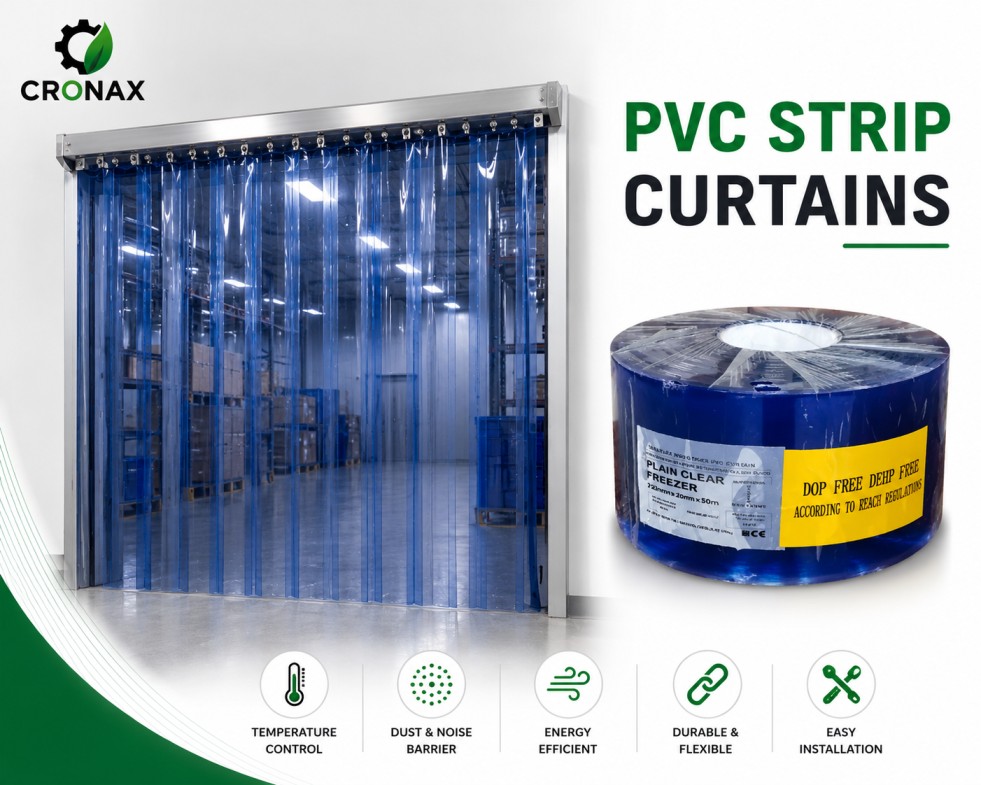
A PVC strip curtain is a set of overlapping transparent flexible strips hanging in a doorway. Workers, forklifts, and pallet trucks pass through without stopping — the strips part and fall back into place on their own.
What this simple mechanism provides in a cold storage environment is a continuous thermal barrier. The overlapping strips trap cold air inside and resist warm air infiltration from outside. Unlike a solid door, the curtain doesn't require anyone to open or close it — which means the thermal barrier is in place whether the worker remembers to close the door or not.
In cold room applications, this makes a measurable difference to temperature stability inside the storage area. Facilities that have switched from unprotected open doorways to PVC strip curtains consistently report more stable internal temperatures, less refrigeration compressor cycling, and lower electricity consumption — particularly during peak summer months when the temperature differential between inside and outside is at its greatest.
For Punjab's cold storage operators managing thin margins between input costs and market prices, these savings are not trivial.
The Energy Cost of an Unprotected Cold Room Door
To understand why strip curtains matter, it helps to think through what an unprotected doorway is actually doing to a cold storage facility's energy consumption.
A cold room maintaining 4°C in a Punjab summer, with 42°C ambient temperature outside, has a 38°C temperature differential across the doorway. Every time that doorway is opened without a barrier, warm air rushes in and cold air spills out — driven by both the temperature differential and the air currents created by movement through the opening.
Refrigeration systems respond by running longer cycles to pull the temperature back down. Over a full day of active operations, this additional compressor run time accumulates into a meaningful increase in electricity consumption — particularly in facilities running older refrigeration equipment that's already working near capacity during summer.
Industry experience with PVC strip curtains in cold storage applications suggests energy savings in the range of 20 to 40 percent at actively used doorways, depending on traffic frequency, opening size, and ambient conditions. For a large cold storage facility in Ludhiana or Amritsar running high compressor loads through a Punjab summer, those savings represent real money.
Getting the Specification Right for Cold Storage Use
Not all PVC strip curtains perform equally in cold storage environments — and this is where many Punjab facilities have been disappointed by their initial purchase.
Polar-grade PVC is non-negotiable. Standard PVC strip curtains become stiff and brittle at low temperatures. In a cold room maintained at 2°C to 4°C, a standard strip loses its flexibility, cracks along fold lines, and no longer returns to position after someone passes through. This destroys the thermal seal the curtain is supposed to maintain. Polar-grade strips are formulated to remain flexible at temperatures down to -20°C — staying pliable, returning to position cleanly, and maintaining their overlap seal throughout the cold room's operating temperature range.
Strip thickness for traffic type. Cold storage facilities in Punjab range from walk-in produce stores with pedestrian-only access to large facilities with regular forklift and pallet truck traffic. Strip thickness needs to match traffic — 2mm for pedestrian areas, 3mm to 4mm for forklift lanes where impact resistance matters. A thin strip in a forklift-traffic doorway tears quickly and requires frequent replacement.
Overlap percentage for thermal sealing. More overlap between adjacent strips means a tighter barrier and better thermal performance. For cold rooms where temperature control is critical, 50% overlap is a minimum — meaning each strip covers half the width of the adjacent one. Some cold room applications with very tight temperature tolerances go to 65% or 70% overlap.
Suspension hardware for cold and humid conditions. Cold room environments are tough on hardware. Condensation, cleaning chemical exposure, and the mechanical stress of thousands of daily strip deflections all affect mounting hardware over time. Stainless steel suspension rails and brackets outlast standard mild steel hardware significantly in cold storage environments — reducing the frequency of hardware replacement and the risk of a failed bracket dropping strips mid-operation.
Cronax Industries — PVC Strip Curtain Manufacturer for Punjab's Cold Storage Sector
Cronax Industries manufactures and supplies PVC strip curtains for cold storage facilities, agri-logistics operations, food processing plants, and dairy facilities across India — including Punjab's active cold chain corridor spanning Ludhiana, Amritsar, Jalandhar, Patiala, and surrounding agricultural districts.
Their cold storage range is built specifically around polar-grade PVC that maintains flexibility at low operating temperatures, with strip thickness options matched to the traffic type at each doorway and overlap configurations suited to the temperature requirements of the storage application.
Suspension hardware supplied by Cronax for cold storage applications uses stainless steel and treated aluminium components that resist corrosion in humid cold room environments — addressing the hardware failure mode that causes early replacement in facilities that specified standard hardware initially.
As a PVC strip curtain manufacturer with direct experience in agri-cold chain applications, Cronax understands the specific combination of high summer ambient temperatures, demanding operational throughput during harvest seasons, and the long storage periods Punjab's agricultural produce requires. The specification that works for a wheat cold store in Ludhiana is different from what a vegetable distribution centre in Amritsar needs — and Cronax works through those differences before supply.
For cold storage operators across Punjab planning new installations, replacing underperforming curtains, or expanding capacity to meet growing agri-logistics demand, Cronax brings both the right product and the application knowledge to specify it correctly.
The Gap That Costs the Most Is the One at the Door
Punjab's cold storage infrastructure is expanding. Government schemes, private investment, and growing export ambitions are adding capacity across the state's agri-logistics network.
The investment in refrigeration equipment, insulated panels, and temperature monitoring is significant. The investment in a properly specified PVC strip curtain at every active doorway is comparatively small — and it's the one that determines whether all that refrigeration investment actually performs as intended.
A cold room that maintains stable temperature through active loading operations, that doesn't spike every time a worker moves a pallet through, that keeps its compressors running efficiently rather than fighting to recover from repeated thermal breaches — that's a cold room that protects both the produce inside and the margins of the business running it.
The door is where that performance is either protected or lost. A polar-grade PVC strip curtain from a manufacturer who understood what the application needed is what makes the difference.
Cronax Industries manufactures and supplies PVC strip curtains, polar-grade cold room strip curtains, and flexible plastic door barriers for cold storage, food processing, and agri-logistics facilities across Punjab and India.