AHU Room Design Guidelines for Industrial and Commercial Buildings
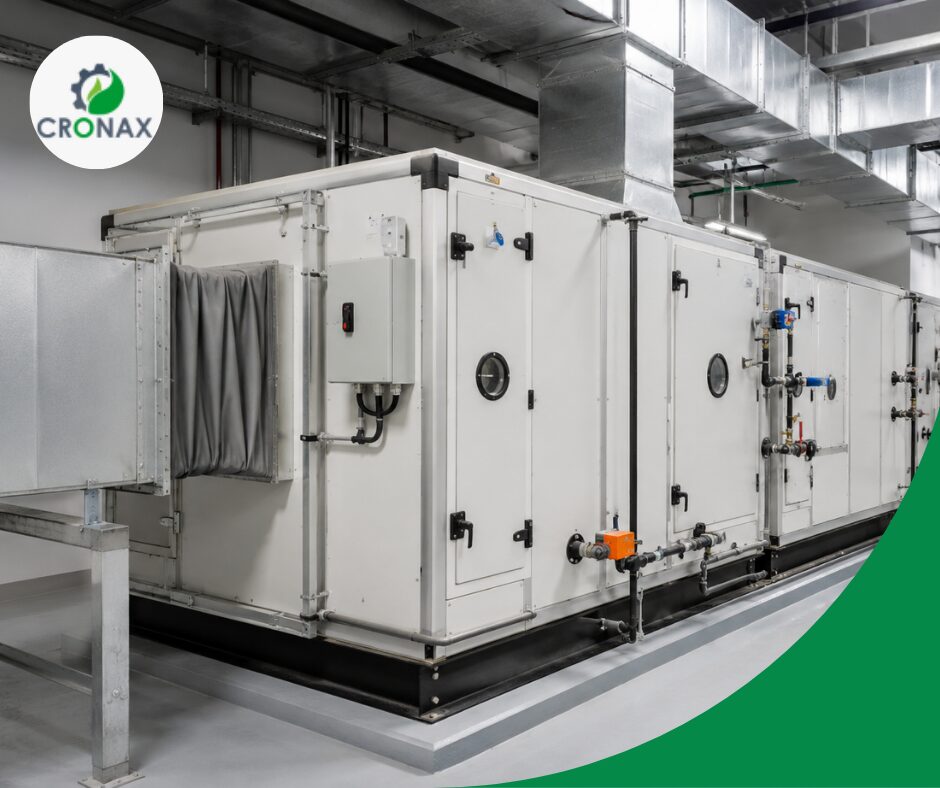
Most decisions about an Air Handling Unit get made early — during design and planning. Once the mechanical room is built, the ductwork is run, and the AHU is commissioned, changing anything becomes expensive and disruptive.
The problem is that AHU room design is often treated as an afterthought. Space gets allocated after everything else is planned. Dimensions get squeezed. Access panels end up facing walls. Drain lines get routed inconveniently.
Then the facility goes live, and the maintenance team inherits a room that was never really designed to be worked in.
This doesn't have to happen. Getting an AHU room right isn't complicated — but it does require thinking through a few things before the slab is poured.
What an Air Handling Unit Actually Does
An Air Handling Unit is the central component of an HVAC system that conditions and circulates air throughout a building. It draws in return air from occupied spaces, filters it, heats or cools it, controls humidity, and pushes it back out through the supply ductwork.
Depending on the application, an AHU may also introduce fresh outdoor air — either for ventilation requirements or to maintain specific pressure relationships between zones.
In industrial settings, AHUs handle large volumes of air across manufacturing floors, cleanrooms, warehouses, and process areas. In commercial buildings — offices, hospitals, hotels, malls — they serve zones, floors, or entire wings.
The AHU diagram for any facility maps out how air moves from the unit through supply ducts to diffusers, and back through return grilles and ducts to the unit again. Getting this flow path right on paper is the first step. The AHU room is where that flow path begins and ends.
Why AHU Room Design Gets Underestimated
An AHU room isn't glamorous. It's a mechanical space — noisy, often warm, full of equipment that most building occupants never think about.
But what happens inside that room directly determines the air quality, temperature consistency, and energy efficiency of every space the system serves.
A poorly designed AHU room creates problems that don't always show up immediately. Inadequate clearance makes filter replacement a two-person job that takes twice as long as it should. Poor drainage causes standing water and microbial growth inside the unit. Insufficient structural support causes vibration that travels through the building. Badly positioned access doors mean coils and fans that were never properly cleaned because reaching them was too awkward.
Over time, these maintenance gaps compound. Air quality drops. Energy consumption rises. The system that was supposed to serve the building starts costing more than it should to keep running.
Key Design Guidelines for AHU Rooms
Size the room for maintenance, not just installation.
The AHU itself has a footprint — but the room needs to accommodate more than that. Coil pull-out space, filter access clearance, fan and motor maintenance access, valve and control panel reach — all of these require clearance beyond the unit's physical envelope.
A standard guideline is to maintain at least one metre of clear space on service sides of the unit. For large industrial AHUs, more is better. The access you plan for during design is the access the maintenance team will actually use for the life of the building.
Get the structural slab and vibration isolation right.
AHUs generate vibration. Without proper isolation, that vibration transmits through the structure — showing up as noise and movement in occupied spaces, particularly in offices, hotels, and hospitals directly above or adjacent to the mechanical room.
Spring isolators or anti-vibration mounts under the unit, combined with flexible duct connections at supply and return openings, manage this effectively. The structural slab also needs to be rated for the unit's operating weight — which includes the weight of water in cooling coils and condensate collection.
Plan drainage before anything else is finalised.
Cooling coils produce condensate. Drain pans need to drain to a floor drain or dedicated condensate line — with a trap to prevent sewer gases from entering the air stream.
The floor of an AHU room should slope toward a drain. This sounds obvious, but a surprising number of AHU rooms have flat floors, leading to standing water that causes corrosion, biological growth, and eventually air quality issues in the spaces the unit serves.
Ventilation for the AHU room itself.
The mechanical room gets warm from heat rejection and equipment operation. Without adequate ventilation, room temperatures rise — affecting motor and drive performance, and making maintenance work uncomfortable and potentially unsafe during summer months.
Exhaust ventilation sized for the heat load in the room is a basic requirement that sometimes gets skipped during design.
Duct entry and exit positioning.
Where supply and return ducts connect to the AHU has a significant impact on air distribution efficiency. Abrupt bends immediately at the unit connection create turbulence and pressure drop. Straight duct runs before bends, and properly designed transitions at connections, keep the system performing as designed.
The AHU room layout should accommodate clean duct entry and exit geometry — not force the ductwork into awkward bends because the room wasn't sized to allow better routing.
Acoustic treatment.
In commercial buildings — particularly hotels, hospitals, and offices — AHU noise reaching occupied spaces is a genuine quality-of-life issue. Acoustic lining inside the AHU room, along with lined ductwork for the first few metres out of the unit, reduces breakout noise significantly.
For industrial facilities, this is less critical — but in any application where the AHU room is adjacent to offices or meeting rooms, acoustic design deserves attention.
Industrial vs Commercial AHU Rooms — What Changes
The core design principles are the same, but the specifics shift.
Industrial AHU rooms typically handle larger units, higher airflow volumes, and more demanding filtration requirements. Cleanroom facilities, pharmaceutical plants, and food processing units often need HEPA or ULPA filtration stages, humidity control within tight tolerances, and redundant units for continuous operation. Space for filter stages, access for filter changeout, and pressure relationships between the AHU room and adjacent spaces all become more critical.
Commercial AHU rooms — in office buildings, malls, hotels, and hospitals — tend to prioritise noise, aesthetics of the mechanical space, and ease of routine maintenance. Energy recovery ventilators and variable air volume controls are common additions. The room design needs to accommodate controls panels and BMS connections cleanly.
Cronax Industries — AHU Room Solutions for Industrial and Commercial Projects
Cronax Industries works with industrial and commercial facilities on Air Handling Unit room design, supply, and installation — bringing together the mechanical, civil, and controls requirements that a well-functioning AHU room demands.
Their experience spans pharmaceutical cleanroom AHU setups, industrial manufacturing ventilation, commercial HVAC installations, and hospital air distribution systems — applications where getting the AHU room design right from the start is not optional.
Cronax helps project teams think through room sizing, drainage, vibration isolation, duct geometry, and filtration requirements during the design phase — before decisions get locked in by construction. That early-stage input is where the most value gets created, and where the most expensive mistakes get avoided.
For industrial and commercial projects planning new AHU installations or upgrading existing mechanical rooms, Cronax brings both the product supply and the application knowledge to make the room work properly for the life of the building.
The Room Behind the Air
Every office, ward, hotel room, and cleanroom that feels comfortable and breathes well has an AHU room somewhere doing quiet, continuous work.
Most building occupants never see it. Most facility managers only think about it when something goes wrong.
The best time to get it right is before construction starts. The second best time is before the next major HVAC upgrade. Either way, the principles don't change — space for maintenance, proper drainage, vibration isolation, clean duct geometry, and a room that was actually designed to be worked in.
Get those things right, and the system takes care of itself for years. Get them wrong, and the maintenance team will be dealing with the consequences for just as long.
Cronax Industries supplies, designs, and commissions AHU rooms and Air Handling Unit systems for pharmaceutical, industrial, commercial, and institutional facilities across India.